Monday, February 22, 2010

Panda à Paris

People we haven't seen in a while (like Talya and Ari, our current visitors) always ask how Panda is adjusting to life in Paris, usually with the implied subtext of her anxiety issues. We always say she's doing great, and then have a hard time describing what exactly is so great about her life here. Maybe pictures would help.

Mostly, Panda's life is great because she spends so much of it sleeping. She probably sleeps - or lays down, curled up or sprawling on her side - around 20 hours a day. You'd be pretty satisfied with your life too if you slept that much.

Nap time

Of the four hours per day she's awake, a good hour and a half is devoted to walks. We take Panda to the Parc des Buttes Chaumont morning and afternoon, and to her special nighttime pee spot just before bed. In the park, Panda frequently runs off-leash, especially when there are other dogs around. But even when we keep her on-leash, she still gets to make plenty of new friends. We're slowly but surely learning the names of the dogs (if not the dog-owners) who are "regulars" at morning romps.

DSC_0027DSC_0071DSC_0014

Then there are more infrequent adventures, like going on errands with one or both of us, hanging out at a café, or catching a glimpse of a stilt-walking lesson.

Panda rides the métroGirl on stiltspanda in a restaurant!

Yup, Panda's got it made. Now if only she would sleep a little less, and spend a little more time helping me with my research . . .

Panda at work

Sunday, February 21, 2010

V is for Vélib'

Don't tell my mom, but I've been riding bikes in Paris. Yes, I said bikes - tons of 'em. With the help of my (crucial) French bank card, I signed up for Vélib' (short for Vélo libre, free bike), the city-organized bike-sharing program that other cities, including Boston, are trying to emulate.


We've mentioned Vélib' before, but we've never described it in detail. Before I get into the nitty-gritty, just to keep things interesting, here's a relevant excerpt from an email to my friend Diana:
I just started availing myself of the bike-sharing program they have here (called Velib, the NYT writes about it all the time). The bikes are super heavy and I have to struggle just about as much as I can to attain the speeds to which I'm accustomed (on my road bike in Boston). That means I always arrive at my destination sweaty and flustered. I mostly ride in the bus lanes (which are cyclist-friendly) and try not to get mowed down by psycho motorcyclists. I gloat when I pass a line of 30 cars stuck behind a garbage truck. I am the ONLY cyclist who wears a helmet. Biking through Paris gives me a rush I've never experienced before, and makes me want to bike NYC next time I'm there. Will you ride with me?
IMG_0772

Here's how it works: you have the option of a one-day, week-long or year-long pass, which respectively cost 1, 5, and 29 euros. A pass allows you to take out a bike for up to a half-hour, completely free of charge. The second half-hour costs 1 euro, the next half-hour after that costs 2 euros, and every half-hour after that costs 4 euros. Basically, it gets expensive if you keep the bike more than an hour, and I never do. But as long as you keep it under an hour, riding the bike remains cheaper than riding the métro. And if you return your bike before 30 minutes is up, then wait two minutes, you can take out another bike, starting another 30-minute cycle. You could basically ride all day for nothing more than what it cost to buy the day-, week-, or month-pass! At the bike stands, of which there are roughly 1,450 all around the city and its suburbs (one every 1000 ft.), most people get their bikes by tapping their Passe Navigo (connected to pre-registered accounts) against a sensor that unlocks the specific bike you want. It's also possible to use a European bank card to get a day- or week-pass at the kiosks located in the middle of each bike stand. Once you've taken a bike, you can return it at any station, so you're free to make a series of one-way trips if you like.

IMG_0773

I am a huge, huge fan of Vélib. That said, the system has its shortcomings. On the hilly outskirts of the city (especially Belleville), bikes are in short supply, as people ride them to the center of the city then take the métro back. (For the record, I almost always bring my bike back. I am a good person.) Lots of bikes have also been stolen, although it's hard to believe anyone would steal such a heavy, dorky-looking ride. Another big problem is defective bikes: vandalism has taken its toll, as has wear and tear. Still, as long as you're willing to put in a little effort to find a bike in good, working order, the benefits are much greater than the challenges. 

I'm getting exercise, saving money on métro passes and tickets, learning the city's geography and enjoying its stunning architecture and vibrant street culture, all while getting wherever it is that I need to go. Again, I ask: Will you ride with me?

IMG_0746

Camembert vs. Donut

As expats are wont to do, we've spent a lot of time pointing out cultural differences between France and the US, some more obvious, reasonable, and predictable than others. This next one seems to come pretty much out of nowhere:

DSC_0006

We've already seen that the French use pie charts just like we do (except they call them camemberts). The above poll seems to call for a camembert, but instead we get a donut. Curious indeed.

(Just in case you're wondering, the poll appeared in a December issue of the free, daily newspaper Metro and measures French perceptions of the crise economique, which has a much more dramatic ring to it than "Great Recession.")

Saturday, February 20, 2010

Opéra de Compiègne

On January 31st, Maggie and I headed out of the city with my piano accompanist and friend, Dominique, who had invited us to go to the Opéra de Compiègne with him. Compiègne is a city of around 40,000 an hour to the northeast of Paris and boasts a fine château and forest, both of which have some historical importance (armistices ending WWI and ending the German invasion of France during WWII were signed in the forest). Napoleon III liked the château enough to tack on a sizable opera house in the mid-19th century, which became the Théâtre Impérial de Compiègne. It was there that we were to see a two-part production: Le Gendarme Incompris (1920), a play by Jean Cocteau and Raymond Radiguet with incidental music and songs by Francis Poulenc; and Les Mamelles de Tiresias, an opera bouffa by Poulenc based on Guillaume d'Apollinaire's 1903 play. This was a great pre-birthday present, since my dissertation focuses on all these early-20th-century artists, and since Poulenc is one of my favorite composers.

(Thanks to the Compiège Tourism Office for this shot of the Théatre Impérial.)

We had a hard time understanding Le Gendarme Incompris, what with the cross-dressing, affected Italian accents, and the lack of sub- or surtitles. In fact, I fell asleep partway through (I'm terrible!) and totally missed the following scene, which included one of Poulenc's songs. (This clip is from a 2009 production in Toulon.)


We still couldn't tell you exactly what Le Gendarme incompris is about, but c'est pas grave (it's no big deal), because Dominique couldn't explain it to us afterwards either.

On the other hand, I already knew Les Mamelles de Tirésias from reading about Poulenc, and from a recording I have. The basic premise of this so-called Surrealist work ("so-called" because it was written before the advent of Surrealism, and because there's no such thing as Surrealist music) is that Thérèse, a normally submissive housewife, rebels against femininity and spontaneously changes sex (her breasts turn into balloons and float away), not only leaving her husband to fend for himself, but becoming a famous general (Tiresias) who leads a successful campaign against childbirth. Her husband, put off by the whole affair and fearful for the future of the country, figures out a way to have children by himself, and manages to (re)produce 40,049 in a single day. At the end Thérèse/Tirésias comes back, repents of her errant ways, and joins the husband and the rest of the cast in singing the praises (literally) of childbearing. The last line of the opera, repeated over and over again in blatant symbolism, urges the French to make as many babies as possible. This was relevant during WWI (when Apollinaire's play was first performed), after WWII (when Poulenc's opera was premiered), and today (when European birthrates are dropping precipitously).

It's a great piece, with lots of catchy tunes and clever orchestration. For a post-war opera, it might be considered a little reactionary (it's a crowd-pleaser), but it's also typical Poulenc, which is what I like about it. For a snippet of the opera, I first offer Poulenc himself accompanying Denise Duval, who created the role of Thérèse/Tirésias in 1947, in a concert version of the beginning of the work. The second clip gives a glimpse of staging, costumes, and the silliness of it all (especially from 1:00 in), from a 2007 Prague State Opera production.


It's delicious stuff, and of course it's best savored live. Afterwards, thanks to Dominique's connections we were able to go backstage, meet the performers, and even go to the cast party! We truly live charmed lives here.

Our Apartment/Impregnable Fortress

Katie and Darryl left this morning after a lovely week-long visit, and now we turn to preparing for our next visitors, who arrive Monday. (Just in case my dissertation adviser is reading this: Yes, I am still researching out the wazoo. In fact, I may have just had my most productive week yet. Maggie does a good job of keeping me on top of things. No matter how many visitors we have, I'm still on track to finish this thing by . . . well . . . sometime around June 2012 or June 2013.)

It seems like every one of our visitors has noticed one thing in particular about our apartment: the door. As you can see below, it is a very secure door. Technically there's only one keyhole, and the same mechanism locks the door in five separate places. And then there's the security latch, which we use at night, just for kicks.

DSC_0001

We're not sure why our door needs to be so secure. Anyone who wants to get in at night first has to know the code to get through the porte cochère or outside door, which lets you into the first courtyard. Then at all times of day there's the door to our building, for which you need a different code. And finally, the outside of our apartment door has no doorknob - there's nothing to jimmy or turn, other than the single keyhole that operates the single five-lock mechanism. If one managed to reproduce the key (which would be no small feat - we had to go to five serruriers (keysmiths) before we could find someone with the right technology) it wouldn't matter if we'd closed the door without locking it, or locked it in five places, since you could easily unlock everything yourself. The only thing these locks seem to defend against is an extremely forceful, direct assault with a medieval battering ram. But if they tried that, we'd pour boiling oil and shoot flaming arrows all over the attackers. 

In the end, our door is just as perplexing to us as to our visitors. And it's not exceptional by French standards. So add our door's quadruply-redundant security to the growing list of things that we don't get, but that we don't mind, because it's all part of the charm of Parisian life.

Friday, February 19, 2010

Le Cinq

Maggie and I had a lot to celebrate this February. My birthday was on the 1st, our 3-year anniversary fell on the 3rd, and of course there's Valentine's Day. Instead of making a big deal out of each one in turn, we decided to make a really, really big deal out of all of them together by treating ourselves to an exquisite meal at a Michelin Guide-starred restaurant. After a great deal of research (notably on foodie forum Chowhound) we chose Le Cinq, the 2-star restaurant of the Hôtel Georges V, one of the most luxurious hotels in Paris. (It's one of the few to rival the Hôtel de Crillon in sumptuousness.)

Now, normally celebrations take place over dinner. But dinner at Le Cinq starts around 250 euros (~$340) per person, not including wine. And that, my friends, is rich. Too rich. So we went for lunch, which has a very reasonable "three-course" menu at 78 euros per person. I put "three-course" in scare quotes because it was actually more like an 8-course meal. Really, what you end up paying for is the overall experience, and ours was worth every euro cent.

Le Cinq

The experience starts when you walk in the room. We were impressed at how tastefully decorated the place was: not nearly as much gilt and marble as we expected, lots of natural light (one good reason to go for lunch), a good balance of ancien régime (aka Louis XIV through Louis XVI) style and clean, modern touches. The white lilies, so fresh and . . . well, white, constituted a theme that ran throughout the hotel. But enough about décor, let's get to the food!

Shrimp tempura

Course #1: Lightly battered fried shrimp and calamari drizzled with fresh lemon juice. Since pretty much anything fried tastes good, we weren't inordinately impressed by the taste of this little amuse-bouche. On the other hand, I for one was awed by the triton-like utensil crowned with a V (for Vendetta?) that we used to spear the little guys. Also, how beautiful is that plate? Very beautiful.

DSC_0003

Prior to our second course, I received the wine menu. It weighed 30 lbs, easily. And of course I ended up just asking the sommelier to recommend something anyway. I started to explain what we had ordered, and he already knew. That's service. He suggested that Maggie try a Madeira with her entrée (appetizer), which we'll get to in a second. I tried a white wine "à l'aveugle" (blind taste test), which turned out to be a Cabernet Sauvignon from New Zealand. Yummy. We also ordered water. I was very careful to ask for "de l'eau du robinet," which means tap water, mostly because we didn't want to pay the exorbitant price we knew would be charged for bottled mineral water, but also because we oppose bottled water in general. Still, whether due to a miscommunication or the possibility that Le Cinq refuses to serve tap water, we were brought a 100 cL bottle of Evian. 12 euros. Only bémol (slip up) of the meal.

Course #2: Not pictured is our palate-cleanser between amuses-bouche - a single slice of country bread that we were instructed to dip in some kind of special extra extra extra virgin olive oil (EEEVOO). You may not consider this a "course," but there was a whole ceremony around it, more so than around the delivery of the fried shrimp. So there.

Butter, Salt, Pepper

As in any restaurant, we were brought a basket of bread - from which we each chose one out of several kinds - and butter. As you can see, the butter was infused with herbs and came in a very refined-looking, bell-shaped container. We want one for chez nous (our place).

Amuses-bouche

Course #3: Three more amuses-bouche, on an awesome trapezoidal plate (modern touch!). From right to left:

DSC_0009

A) Spinach-goat cheese "ravioli" over (what we think is a painter's stroke of) squid ink. Not sure what that spice dusting the top is. We were a little surprised to have two fried bits in such close succession, but didn't mind at all, since they were so different, and since the spinach-goat cheese combination tasted so, so good.

Watercress soup

B) Watercress soup. Striking color, creamy texture, delicious!

Squid and Chives

C) Sautéed squid, flavors reminiscent of East Asian food, topped with chives. Interesting spoon.

DSC_0012

Satisfied with the offerings so far, Maggie beams in anticipation of what's to come. All this from the couch she was sitting on, which made her want to lounge as if that afternoon were different from all other afternoons. 

Coeurs de Saumon

Course #4 (Louis): Coeur de saumon extra-frais en sashimi aux condiments, pommes tiedes / pamplemousse (Extra-fresh salmon "hearts" à la sashimi with "condiments," warm potatoes, and grapefruit)

You know you're at a nice restaurant when translating the menu into English doesn't help you understand the nature of a dish. Basically it was really, really tender raw salmon over single slices of potato and single chunks of grapefruit. Unfortunately the restaurant's description leaves out all the extra, most creative touches: the green, gelatinous disks on each side, topped with Ikura; the little sticks of apple between each piece of salmon, as well as the crunchier yellow sticks whose origin I couldn't identify; and of course the little sprigs of greenery so carefully placed all over the plate. The ensemble was quite impressive.

Foie Gras Chaude

Course #4 (Maggie): Foie gras de canard des landes au gingembre, crème de lentilles du Puy, anguille fumé au Sansho (Warm duck fois gras from Landes with ginger, creamed and whole du Puy lentils, smoked Sansho eel)

We were fascinated by the composition of this dish. First of all, we'd never had warm foie gras before, and it was excellent. Second of all, foie gras with lentils??? But actually it makes sense - the lentils replaced bread as a substantive base on which to perch morsels of foie gras. This was probably the richest dish of all, but not overwhelmingly so. When it was time for Maggie and I to switch plates (so we could each experience as much of Le Cinq's food as possible - very American), the servers rushed over and executed the switch for us. We basically weren't allowed to do anything for ourselves the whole time. We were ok with that.

DSC_0019

Nothing between the entrée and plat, but tant mieux (so much the better), since we were both pretty much already full. We took some time to check out our surroundings. And then . . .


Scallops

Course #5 (Maggie): Noix de Saint-Jacques de Normandie dorée au lard de Saint-Yrieix façon carbonara, chou fondant à la truffe (Normandy scallops browned in Saint-Yrieix bacon à la carbonara, "melting" cabbage with truffle)

Maggie used to dislike scallops, but thanks to this plat at Le Cinq, she is now a fan. It helps that the cabbage was superbly prepared - a slight bitterness, literally melting texture, went perfectly with the scallops. And then the truffle flavor and chunks of lard (not exactly bacon, but close) enriched the overall taste in a surprisingly nuanced manner (usually there's nothing nuanced about anything that tastes like bacon). This picture doesn't really do the presentation justice, but you can kind of make out the mounds of sea foam (écume), the snowflake-like drizzles of cheese, the texture and color of the creamy sauce that everything seemed to float on. This plate shows why Eric Briffand, Le Cinq's chef, is one of the most highly regarded in France.

DSC_0024

Course #5 (Louis): Friton de ris de veau et crevette Carabineros, risotto de seiche au safran / chorizo Iberico (Fried veal sweetbread and shrimp, cuttlefish saffron risotto and chorizo Iberico)

Let me say how incredible everything about this dish was. Presentation: A+. Texture: A+. Taste: A+. Quantity: Way more than I could handle at this point in the meal. It was probably the second-heaviest thing we ate (after Maggie's foie gras), and wasn't nearly as complex in conception or in taste as many of the other courses, but as a bright, warm winter dish, I can't imagine doing much better. 

Cheese Cart

We didn't get a cheese course with our meal (which was probably a good thing, considering how much we ate), but were impressed enough with the mode of transportation and cheese selection that we figured it was worth a picture.

Palate-Cleanser

Course #6: Sugar cookie over vanilla ice cream over finely chopped mango and pineapple over chilled cream. This was intended as a palate-cleanser between the plat and the dessert, and it did the trick - but only for me, since Maggie is allergic to pineapple. By the time I got down to the chilled cream at the bottom, the juices from the mango and pineapple had soaked in, producing an unexpected but delightful taste combination.

4 Bananas Dessert

Course #7: Banane poêlée à la vanille/Kalamansi, meringue noisette, cigare de marscarpone à la banane, sorbet banane caramélisée (Banana pan-fried in vanilla and Kalamansi, hazelnut meringue, banana marscarpone "cigar," caramelized banana sorbet)

I basically have no words to describe this. It certainly beats my lame attempt at a banana-based dessert. Banana mascarpone is my new favorite thing in the world. I didn't know you could stack things like that. I didn't know you could spiral caramel around a cylindrical object like that. I didn't know a lot of things, but now I know where to go for the most creative dessert anywhere.

Pecan Pie

Course #7: Tarte aux noix de pecan et sirop d'erable, crème glacée à la cacahuète (Pecan and maple syrup tart with peanut ice cream)

Not your grandma's pecan pie, this really, really tasted like it was made of nuts rather than karo syrup. And that dollop of peanut ice cream? Also tasted like nuts - actual peanuts, not some manufactured Jiff-scented simulacrum of peanuts. Honestly, though, at this point in the meal we had consumed so much deliciousness in the savory category that we almost, almost didn't want to spoil the memory with a sweet treat. 

DSC_0016


When we first saw this cart go by, we figured that it would go the way of the cheese cart, passing by our table, never to rest close enough for us to steal one of the tiny morsels of sugary goodness it carries. But then we decided to "just look" at the coffee/tea menu, and then we decided we'd just get coffee, and then miraculously, the cart ended up standing right next to our table. The server described all the possibilities, then asked what we'd like. After every piece we took, he'd ask, "Avec ceci?" which is also what they ask at the boulangerie to find out whether we've finished our order (it's the French version of, "Do you want fries with that?"). So we kept taking, and taking . . .

Coffee treats

Course #8: Coffee and mignardises, which are all these mini-desserts that come with coffee at nice restaurants. In the center is a vanilla macaron, at 1:00 is a tartilette framboise (raspberry tartlette), at 3:00 is an opéra (almond cake layered with buttercream and chocolate ganache), then from 6:00 through 11:00 are four different chocolates, flavored with squash (interesting), caramel (excellent), dark and milk chocolate (excellent and excellent). After we finished getting mignardises from the server, he snarked, "It's almost as if you hadn't just eaten lunch." Oops. Luckily he was extremely good-natured, and gave us each a box of caramels-to-go (seen in the background of the picture below).

Coffee

Meanwhile, the coffee wasn't just any regular coffee. Maggie got Kenya, which was full-bodied, complex, and single-origin (as opposed to a blend), and I got Jamaican Blue Mountain, which was mild, not at all bitter, and easily the best coffee I've ever tasted. Along with the coffee came a second bottle of water (we cringed when we saw it), which turned out to be complimentary (along with the coffee, another pleasant surprise). The server introduced the water, called Wattwiller, as one particularly well-suited to accompany our coffees. Normally we're not too partial about our water, but this stuff actually tasted like it deserved to be in a funky-looking bottle

DSC_0044

Our menu de luxe devoured, every corner of the lavish dining room etched into our memories, every other lunch guest departed, we finally left almost 3 hours after arriving. Our short walk from the Hôtel Georges V to its eponymous métro station symbolized our descent from the gastronomic heavens to the harsh, earthly reality of the everyday, where we will probably be eating rice and beans for the rest of our trip. Goodbye, finest-of-the-fine dining! Until next year!

DSC_0052

Métro Deco (Cars)

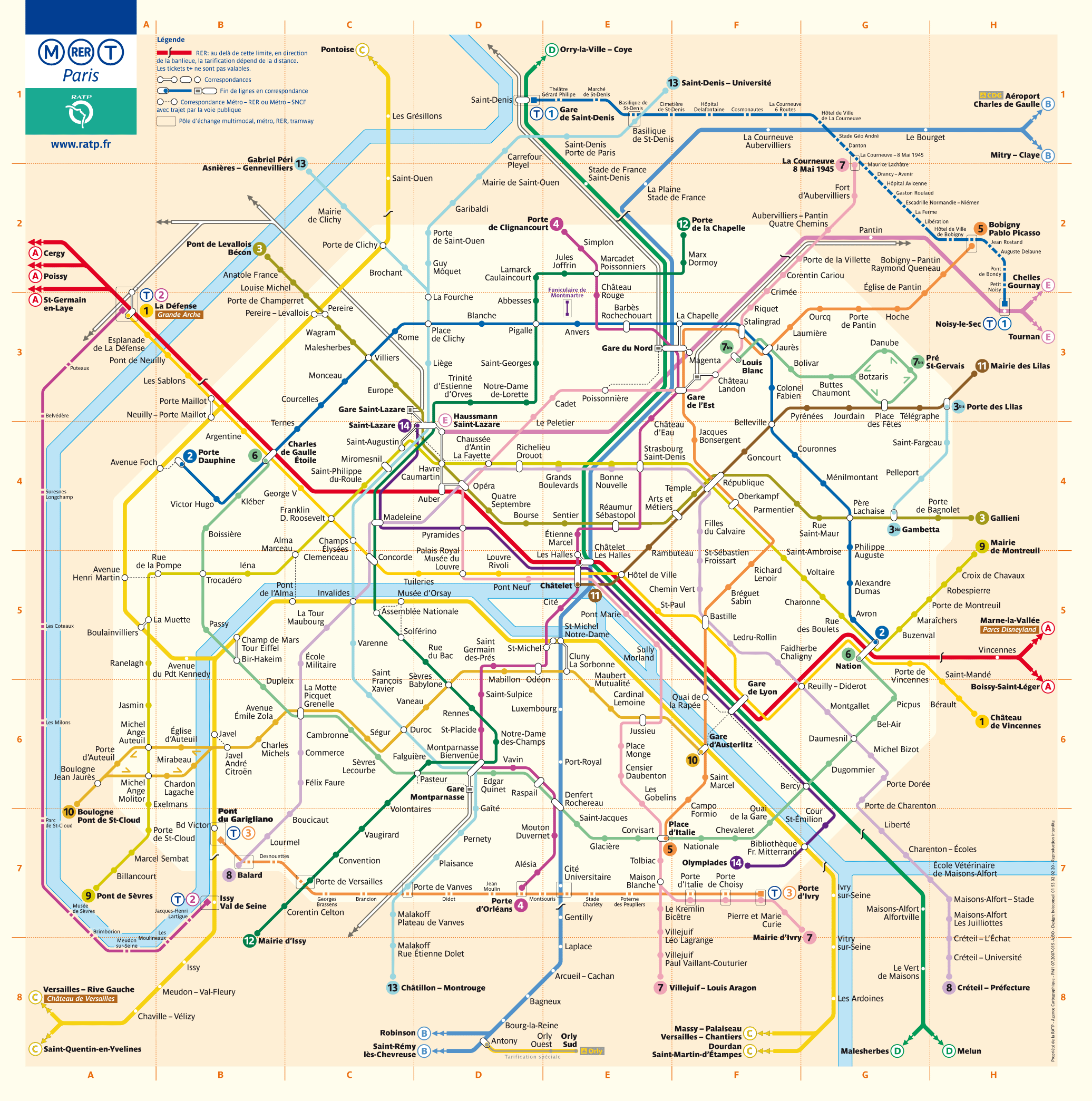
The Paris Métro has the most diverse collection of trains of any city I've ever been to. Lines 1, 2, 3, 9, 13, and 14 all have different kinds of cars. Lines 4, 5, 6, 7, 8, 10, 11, and 12 somehow missed out on the waves of updates that hit the other lines over the last few decades. Line 14 is already fully automated; Line 1 is well on its way. Some day we'll try to take a picture in each kind of métro car without getting arrested by the French version of Homeland Security. Until then, here are some of our favorite métro car decorations.

DSC_0301

This is the car that the majority of the lines use. It's not a great shot of the car itself, but that's not what I was after - see the heart/infinity symbol ("lemniscate") in the window? Coolest métro graffiti ever. How better to tell someone, "I love you forever" than to draw it in lipstick or red magic marker on the side of a métro car?

DSC_0268

In what is maybe an attempt to discourage graffiti, at least one train on Line 1 has been decorated in early-21st-century Coca Cola Style. Despite the crass commercialism of it all - where will they think to advertise next? - I love the brightness of the ad. That standard green-on-white uniform (see above) can feel kind of drab at times. Maybe in the future each line's trains could be decorated with a color scheme that matches the colors used to differentiate each line on the métro map? Just an idea.

Thursday, February 18, 2010

Médiathèque Gustav Mahler


Matt's visit, as I've mentioned before, was all about two things: research and food (in that order). And for someone writing a dissertation on the reception of Gustav Mahler's music in the US, there could be no more obvious place to do research in Paris than the Médiathèque Gustav Mahler (MGM). But it turns out that this "médiathèque" (multimedia library) also has a lot to offer someone working on a non-Mahler topic. So I was only too happy to explore MGM's collections with Matt.

DSC_0243

Matt was super excited to arrive and twice as sad to leave. MGM has tons of clippings of reviews of Mahler performances from newspapers all over the world. Luckily we managed to photograph most of them, which means Matt can continue his archival research from the comfort of Cambridge!

DSC_0239

MGM's rooms are quite a bit nicer than those of any other library I've been to in Paris. It helps that the place is a former apartment in the ritzy 8th arrondissement, just around the corner from Parc Monceau (which ups the ritzy factor immeasurably). They also have open stacks for all their books (not a humongous collection, but completely respectable) and, as you can see, their vinyl and CDs. Wow.

DSC_0426

This is the hallway that connects the two "reading rooms." Notice the lovely tile floor and the bust of Mahler in front of the mirror at the end. It's so pleasant to work at MGM, and they have such useful archives, that since Matt left I've actually taken to spending the majority of my time there. Unlike at the Bibliothèque Nationale, MGM makes it possible to: 1) listen to music while looking at a score (printed or manuscript); 2) read newspaper articles off of something other than microfilm (aka hold newspaper clippings in your hand); 3) stay awake thanks to bright (and mostly natural) lighting; 4) do your own photocopying, and for slightly cheaper. They also have some archival materials that the BN doesn't have, which is the main reason I'm spending time there.

The BN has some advantages over MGM (notably providing archival sources for non-20th-century material) but for ambiance and certain requirements of my own project, MGM is the place to be.

Wednesday, February 17, 2010

A little excitement

On my way back from the library yesterday afternoon, I happened upon a dramatic scene. Remember those fire trucks I profiled way back? Well, I finally got to see them put to good use.

DSC_0064

DSC_0065

Sorry the pictures aren't that great - I'm no photojournalist. Mostly what I saw (along with at least 120 other bystanders) were the firemen breaking the windows to the first floor apartment, seemingly to give the smoke a smoother exit strategy. Passing by the same spot today, the windows were already boarded up. A little excitement had already given way to cold reality.

Don't Eat Here

Paris may be a city filled with fine food, but there's also a lot of terrible food out there. We're usually very careful to avoid that food, mainly going to restaurants that are recommended and/or that we've researched. (We rarely pick a restaurant once we're already out, because every time we do, we pick poorly.) Despite all this, we do have bad meals once in a while, and we feel it's our duty to tell you about them.

Polidor is a famous Left Bank establishment with 100-year-old décor and numerous guidebook recommendations attracting Parisians and tourists alike. Founded in 1845, it has served such literary luminaries as André Gide, James Joyce, Ernest Hemingway and Jack Kerouac, and it remains popular with students, which is no surprise given its relatively low prices and proximity to the Sorbonne. We went on a recommendation from our landlord (who falls into the student category), whom my mom, Cathy, and I met briefly at Berthillon Glace.

DSC_0048DSC_0047

The décor was delightfully old-fashioned and the ambiance certainly qualified as "boisterous" as befits a popular bistrot, but we were pretty disappointed in the food. Cathy was excited to try escargot, and they turned out to be mediocre. The reasonable prices turned out to be high relative to the quality of what we ate, and we were especially disappointed in the desserts, which were dry and somewhat tasteless. So if your guidebook claims you have to go to Polidor, go for a drink or something, and get dinner at nearby Fish La Boissonerie, which remains one of our three favorite restaurants in Paris.

Our other culinary misadventure came during Matt's visit. After consulting Jesse's List, which has proven to be one of our most reliable sources of restaurant recommendations, we decided to try a place in the 9th arrondissement called Carpediem. Unfortunately we don't have any pictures for you, but suffice it to say, nothing was really photogenic enough to merit documentation. Things either tasted or looked bland, and the dishes that attempted to combine unexpected flavors mostly failed. Apparently we weren't the only ones to notice - on a Thursday night, the restaurant was mostly empty from 7:30 to around 10. Not a good sign.

So there you go - two restaurants to avoid the next time you're in Paris. We'll keep recommending alternatives, and hopefully you'll manage what we couldn't: all good food, all the time.
Related Posts with Thumbnails

ShareThis