Showing posts with label books. Show all posts

Monday, April 26, 2010

Book Report #3

I just finished a really bloody, creepy detective novel. It wouldn't have made me quite so nervous if it didn't take place in our neighborhood.


Written in the late-1970s, Babel-ville follows a schizophrenic serial killer as he tries to eliminate the members of an all-female, neo-Saint-Simonian sect operating in Belleville. As is usual for this kind of book, the plot - the mystery - is actually the least interesting aspect, while the psychological side is fascinating. You start out feeling bad for the killer, seeing as how he's just trying to find his "missing" wife, but by the end you mostly just feel revulsion. I'm actually glad I couldn't understand a lot of the more graphic vocabulary, although my imagination probably made up for it.

What I did enjoy were Bialot's descriptions of Belleville in the 1970s, the snapshots into the lives of its residents (not unlike our own), and the unabashed, parodic treatment of the kinds of culture clashes a place like Belleville inspires. The impassioned interactions between the story's detective protagonists and the immigrants/descendants of immigrants they meet during their investigation may have been dramatized for literary purposes, but the ignorance and fear coming from both sides feels authentic enough.

The book's title draws attention to Belleville's multi-linguistic, multicultural demographics. I can't find anything on the etymology of the portmanteau "Babel-Ville," but it's clear that the neighborhood's inhabitants have embraced the notion.

Belleville Pride

Now if only France would follow. Just after finishing Babel-ville, I read a great article in the NYT about French conservatives' inability to cope with the fact that most French-speakers don't live in France, don't subscribe to French nationalist mythologies about a glorious past stretching back to Rome, don't practice Catholicism, and don't appreciate being told what to wear (but that's another issue for another time). Bad news for French conservatives: the article ultimately reinforces the possibility that Belleville's demographics, while not "typical" of Paris past-and-present, are increasingly typical of the city's future.

Thursday, March 11, 2010

Book Report #2

You may remember that we had our neighbors over for an afternoon goûter (snack) in the middle of January. In return, they invited us for dinner in the middle of February, and a lovely time was had by all. At the dinner, they surprised me with a birthday present: three books, all recommended highly by Mo and Héloise. (I'm sure their three boys will like these books too, but for now they're too young to read them.) Having just finished the third one, and never having gotten into the whole goodreads.com thing, I thought I'd mention them here.


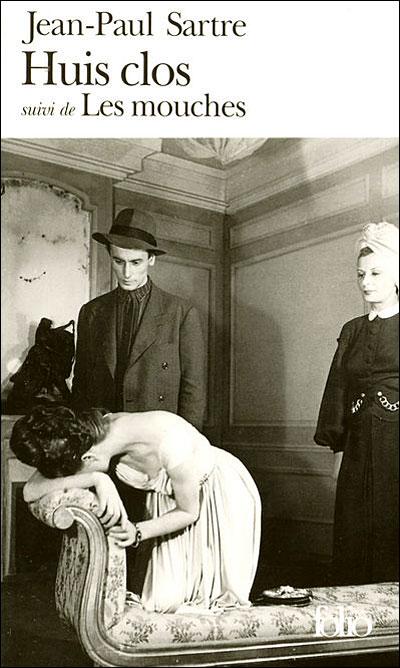
I'm not sure why these two plays by Sartre were published together (maybe because they were published in 1944 and 1943, respectively), but I am sure that I enjoyed reading them much more than I expected. (Doesn't "Sartre" conjure up anxiety about heavy, difficult-to-understand reading? It did for me. But no more.) Huis clos (translated in English as No Exit) puts three guilty people in a recognizable (albeit reimagined) place and lets us watch their inevitable conflict. Les mouches (The Flies) is a retelling of the Electra myth (previously treated by Sophocles, Aeschylus, Euripides, and Richard Staruss) through a (you guessed it) existentialist lens. If that doesn't get you all excited, read the play anyway, its energy and power merit a much more breathless description.


With its deceptively simple title (A French Novel), the second book proved more difficult but, at the same time, was also lighter reading than the Sartre. Frédéric Beigbeder won the 2009 Prix Renaudot for this almost painfully autobiographical work that starts with his arrest for sniffing cocaine off the hood of a car. The author uses the incident - and his ensuing two-night imprisonment - to explore the reasons for his inability to remember anything about his admittedly privileged childhood. His narrative mixes idyllic flashbacks with harsh critiques of the French criminal justice system, his prose is completely contemporary, and his sarcasm reminds me of Chuck Palahniuk (who, now that I think about it, also structures books so that the end comes right at the beginning). One of the great things about this book is its short (3-4 page) chapters, which make it easy for a non-native-French speaker to sustain interest. In this respect Beigbeder does not equal Victor Hugo, and I am grateful for that.

As an aside: one of our favorite American-in-Paris bloggers noticed that the covers of French books tend to be extremely simple, and Un roman français is a great example.


Finally, I read this novella on my way to and from a single rehearsal, it's that short. Originally published in English in 1938 (funny that I should read it in French translation), Inconnu à cette adresse (Address unknown) constitutes an exchange of letters between German business partners originally living in San Francisco. The exchange begins when Martin, who is not Jewish, returns to Germany with his family in 1932, while Max, who is Jewish, stays behind to run the business. Over the next two years, their close friendship breaks down under the strain of the sinister changes German society experiences under National Socialism and Adolph Hitler. The author, Katherine Kressman Taylor, based parts of the book on actual letters sent by Americans in Germany during the 1930s. We don't often hear about the extent to which Americans knew what was going on in Germany during the buildup to the Holocaust, and it's moving to get a contemporary glimpse from someone who had no personal stake in the violence, but who clearly felt its effects.

I'd like to take this opportunity to thank Mo & Co. (which is a decent band name, should the boys ever decide to take up guitar and drums) for their generosity and thoughtfulness. And to anyone who's looking for good reads in French or English, I highly recommend these three books!

Thursday, February 11, 2010

Zazie dans le métro . . . dans le métro

Today, I finished reading this book:

It was more challenging than I expected, because Raymond Queneau uses all kinds of quasi-phonetic spellings that reflect the way people speak, rather than the way the Academie Française wants speech to sound like. Examples from the first three pages:
  • Doukipudonktan (first word in the book, its official spelling is "d'où qui pue donc tant" and means "where's that terrible smell coming from"); 
  • ptite/ptit ("petite/petit")
  • Skeutadittaleur ("ce que tu as dit toute à l'heure", "what you just said")
  • vlà ("voilà")
  • Chsuis ("je suis" - I remember wondering why kids in my sophomore-year French class had come back from a trip to France saying this)
  • Çui-là ("celui-là")
You get the idea. At times I actually had to say words out loud a few times to figure out what the spelling was supposed to indicate. Also there's tons of slang, colloquial phrases, and stylistic characteristics that clearly exist to confuse non-native speakers. So like I said, challenging. But also incredibly entertaining - it's the story of a young girl (Zazie) from some French province who is left with her uncle in Paris for two days so her mom can shack up with some guy. Zazie is spunky, to say the least, and desperately wants to see the métro. Unfortunately there's a strike, so she has to find other ways of seeing the city, most of which include evading her uncle and running into a host of unsavory characters. In 1960, Louis Malle made a movie out of the story, which was Queneau's first big success.

I mostly read the book in the métro, congratulating myself often on reading Zazie in the métro in the appropriate place. But it turns out Zazie never spends any significant time in the métro - oops. Luckily there were plenty of hilarious hijinx to keep me entertained no matter where I was reading. Example: During a fight scene , we read, "Zazie, de nouveau, dormait. Laverdure, sans doute dans un esprit de vengeance, essayait de projeter un excrément frais hors de sa cage." ("Zazie was sleeping again. Laverdure [a parrot], no doubt in a vengeful spirit, tried to eject fresh poop from his cage.")

I really enjoyed this book, and I think you would too. But you don't have to take my word for it . . .

Sunday, September 20, 2009

Cover of a cover

A few days ago, we walked through the Jardin de Luxembourg and stumbled upon a vista that was eerily familiar...


Before I left Boston, my dear friend and colleague Julia gave me a wonderful book titled The Sharper Your Knife, the Less You Cry. This true story of a woman who pursues her dreams in Paris was the perfect summer pre-Paris reading - thanks, Julia!

Anyway, check out the cover of the paperback version:


We did a pretty good job recreating this image, don't you think?

Friday, June 19, 2009

A Year in the Merde


or, A shameless plug for a funny book.
I got Maggie a copy of Stephen Clarke's A Year in the Merde (2004), a pseudo-autobiographical novel about his time in France, to celebrate our year of colocation. She read it, and now I'm reading it. It's pretty funny, especially the transcriptions of heavily French-accented English. The title refers to the protagonist's unfortunate habit of stepping in every pile of dog poo he comes near (a result of Parisians' unfortunate habit of not picking up after their dogs), as well as an idiomatic French expression meaning "to be in the thick of things."
I highly recommend the book, and I'll probably refer to it again in future blogs - especially once I, too, fall victim to the bane of Parisian streets . . .
Related Posts with Thumbnails

ShareThis