Showing posts with label metro. Show all posts

Sunday, May 30, 2010

Reward

At the end of a long afternoon spent exploring large swaths of the 16th arrondissement, this was the icing on the cake:

Original Guimard Métro entrance

It's the only remaining original "bouche de métro" (metro entrance) designed by Hector Guimard, the famed Art Nouveau architect!

Guimard bouche de métroGuimard bouche de métro

There's so much detail to take in, I just had to approach slowly and take a picture every few feet. Finally, when I got up close to those brown-and-green interior panels, I weirded out all the people coming out of the métro while I waited, camera to the ready, for the perfect shot.

Interior, Guimard bouche de métro

Well, maybe not perfect. But how ridiculous is this? We heart Art Nouveau. And strongly believe that whoever tore down or partially dismantled the other Guimard stations should be prosecuted, even posthumously.

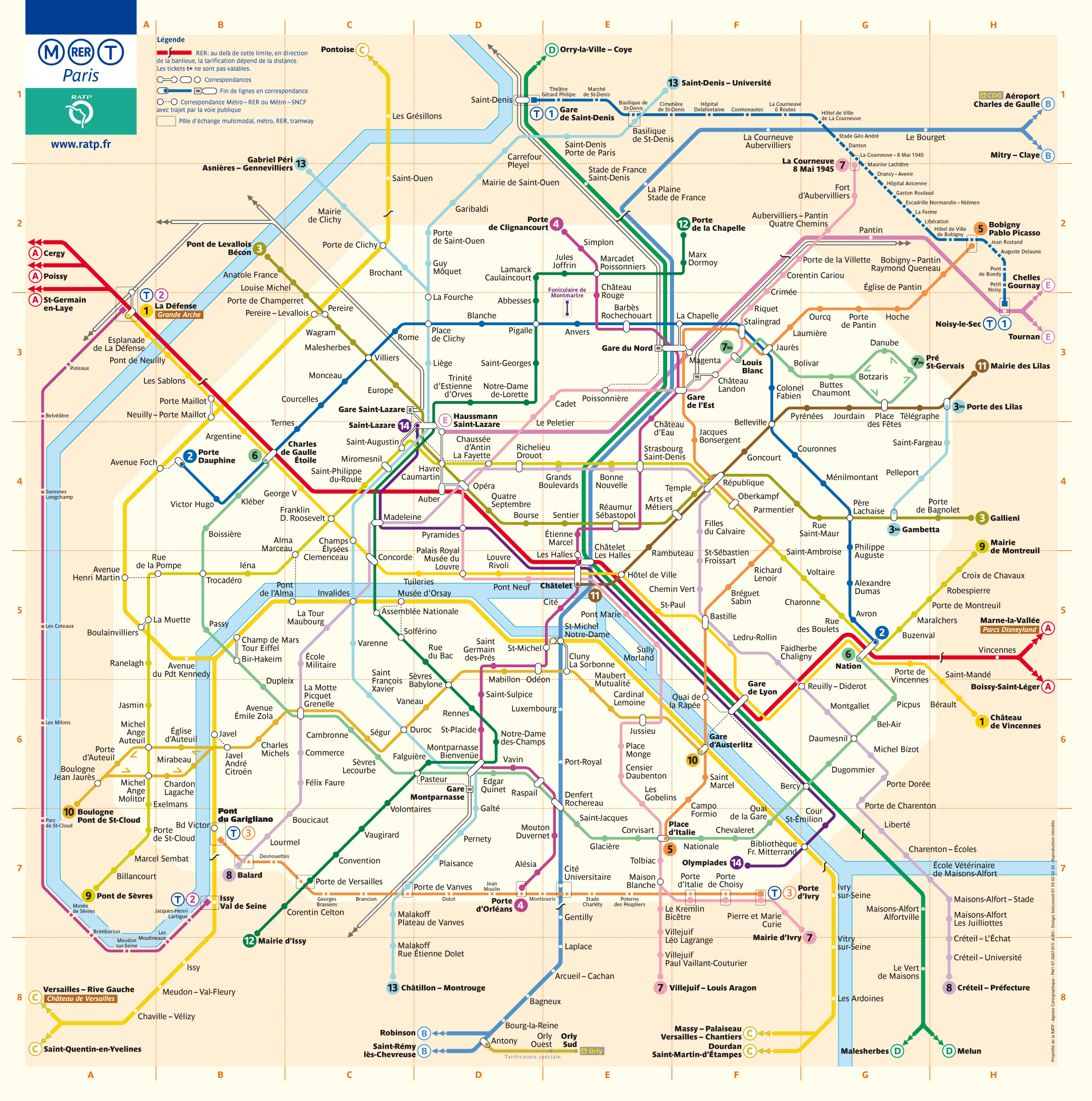
You'll find this turn-of-the-century gem at Porte Dauphine, terminus of Ligne 2, 16th arrondissement. Recommended approach: start at the Arc de Triomphe and walk all the way down Avenue Foch. Just don't do it at night.

Friday, May 28, 2010

The Shield

If you ever find yourself at the Hôtel de Ville métro station, waiting for the Ligne 1 to take you in the direction of La Défense, you might notice this mosaic on the wall.

DSC_0002

Ok, it's a coat of arms thingy, the medieval shield of some noble family. You take a picture of it, thinking it's kind of cool, and you move on. End of story.

Except then you start seeing the shield everywhere, in different materials, colors, historical styles, and designs.

You see it on the Vélib' stations, on the Mairie of the 2e arrondissement, and on an awesome Art Deco school in the 11th.

Paris Coat of Arms: Vélib'Paris Shield, Mairie IIeDSC_0002

You see one-sail, two-sail, red-sail, blue-sail versions - used as a distinctive logo for elementary schools, and on the guardian's building at the entrance to the Parc des Buttes Chaumont that you took a dozen pictures of over the course of the year. (How did you not notice this before??)

Paris Coat of ArmsDSC_0165

This thing is literally everywhere, especially in its present-day iteration, a simple, curved, diamond-shaped sail on a crescent-shaped boat. You see this boat on all park signs, on the backs of public toilets, and on trash and recycling bins.

DSC_0003DSC_0012DSC_0007

When you look it up on Wikipedia, you learn lots of interesting things. The boat symbol on the city's coat of arms dates from around 1190 but was made official in 1358 by King Charles V (who also completed and lived in the donjon at the Château de Vincennes). The boat looks good on the entrance gate to the Parc Monceau, and on the centerpiece of the Pont Alexandre III (an epic bridge).

Paris Coat of ArmsParis Coat of Arms

In its pure form (best represented by the mosaic at the Hôtel de Ville métro station), a single-sail, white boat floats on water within a field of red. Above, yellow fleurs-de-lys suspended in a blue field represent French royal power, and specifically that of the Bourbon royal line. The blue and red in the coat-of-arms represent the Paris Commune, a revolutionary body that provided the same colors to the tricolor French flag we know today. But even uncolored it gets its point across, like when it's tacked onto an electricity meter, or yet another school in the 20th, or a "Theatres of Paris" cylindrical billboard.

DSC_0046DSC_0008DSC_0002

The ship and the motto, "Fluctuat nec mergitur," or "It is beaten by the waves without being submerged," pay hommage both to the city's resilience in the face of millenia of attacks and to the power of the medieval shipping guilds. I wonder how those medieval dudes would have felt about having a symbol of their power sculpted in iron on a fence outside a park, or on yet another school.

DSC_0163DSC_0004

Clearly, this city has some kind of complex. Or a very, very savvy and consistent marketing campaign aimed at subtly marking the city's influence on everyday life. Whatever they're doing, I'm hooked on finding more of these. At least until another of Paris's many open but overlooked secrets catches my eye . . .

Wednesday, May 26, 2010

Paris Hearts US?

Based on our experiences this year, there's no anti-Americanism here. There's opposition to the wars in Iraq and Afghanistan, sure, as well as other complaints about the US government and US politicians. But we've never told anyone we're Americans and received a negative response. Maybe people are just being polite. But we're pretty sure the city's pro-Americanism runs deep.

Deep underground, that is. Consider the décor for the Cadet metro station.

Métro Cadet decoration

Never mind that the 13-star flag hasn't been in use since 1795, and that the sentiment here has more to do with the links between the American and French revolutions than with current political or social amity. Whatever - we know this flag proves that Paris hearts the United States. Yet another reason why we heart Paris.

Sunday, May 23, 2010

Think About It

We've always been aware of the differences between French and American concepts of "personal space," but one particular example really drives the point home. Here's something that would never fly in American public transportation:

DSC_0003

I'm curious whether anyone can provide an example of a public transportation seating arrangement in the States that puts people in such close, face-to-face contact. (Amtrak's facing seats with tables in between the people don't count. We're talking knee-to-knee tactile communication here.)

Sure, people on the NYC subway crowd into cars and end up doing an unintentional bump-and-grind, but they're standing, and have the option of facing away from each other. On the Paris métro, if you want to sit on something other than a strapontin (foldaway seat normally placed near the doors), you've gotta get up close and personal.

DSC_0178

Not that that's always a bad thing . . .

Tuesday, May 11, 2010

Métro Manifesto

Want to know the hot-button topics in French culture? Just take the Métro. There are all kinds of provocative stickers attached to the walls and windows of every train.

DSC_0010

France supports the Palestinian Authority and the notion of a Palestinian state in ways the US can't even contemplate. There's also a current of sentiment against what we might call the Israeli "occupation" of Palestinian territory, but what they would call "colonization." Fascinating.

DSC_0123

Apparently, 40 years after women's lib, the French still aren't getting the message about equality in the home. This sticker suggests that women and men "everywhere" should "split chores, all the time." (Tâches could also just refer to tasks or responsibilities in general, but I like reading it as "chores.")

Alas, we didn't get a picture of the iconic purple No Sarkozy Day stickers, but at least we caught that anti-horse meat ad campaign way back in the fall . . .

Another thing the Métro is good for: promoting safe sex. Now in "his" and "hers" versions! (It seems unfair that he gets four for two euros, while she only gets one.)

DSC_0116

Maybe the Métro's new slogan should be, "It helps you get around." (Or maybe you can come up with something better . . .)

Monday, February 22, 2010

Panda à Paris

People we haven't seen in a while (like Talya and Ari, our current visitors) always ask how Panda is adjusting to life in Paris, usually with the implied subtext of her anxiety issues. We always say she's doing great, and then have a hard time describing what exactly is so great about her life here. Maybe pictures would help.

Mostly, Panda's life is great because she spends so much of it sleeping. She probably sleeps - or lays down, curled up or sprawling on her side - around 20 hours a day. You'd be pretty satisfied with your life too if you slept that much.

Nap time

Of the four hours per day she's awake, a good hour and a half is devoted to walks. We take Panda to the Parc des Buttes Chaumont morning and afternoon, and to her special nighttime pee spot just before bed. In the park, Panda frequently runs off-leash, especially when there are other dogs around. But even when we keep her on-leash, she still gets to make plenty of new friends. We're slowly but surely learning the names of the dogs (if not the dog-owners) who are "regulars" at morning romps.

DSC_0027DSC_0071DSC_0014

Then there are more infrequent adventures, like going on errands with one or both of us, hanging out at a café, or catching a glimpse of a stilt-walking lesson.

Panda rides the métroGirl on stiltspanda in a restaurant!

Yup, Panda's got it made. Now if only she would sleep a little less, and spend a little more time helping me with my research . . .

Panda at work

Sunday, February 21, 2010

V is for Vélib'

Don't tell my mom, but I've been riding bikes in Paris. Yes, I said bikes - tons of 'em. With the help of my (crucial) French bank card, I signed up for Vélib' (short for Vélo libre, free bike), the city-organized bike-sharing program that other cities, including Boston, are trying to emulate.


We've mentioned Vélib' before, but we've never described it in detail. Before I get into the nitty-gritty, just to keep things interesting, here's a relevant excerpt from an email to my friend Diana:
I just started availing myself of the bike-sharing program they have here (called Velib, the NYT writes about it all the time). The bikes are super heavy and I have to struggle just about as much as I can to attain the speeds to which I'm accustomed (on my road bike in Boston). That means I always arrive at my destination sweaty and flustered. I mostly ride in the bus lanes (which are cyclist-friendly) and try not to get mowed down by psycho motorcyclists. I gloat when I pass a line of 30 cars stuck behind a garbage truck. I am the ONLY cyclist who wears a helmet. Biking through Paris gives me a rush I've never experienced before, and makes me want to bike NYC next time I'm there. Will you ride with me?
IMG_0772

Here's how it works: you have the option of a one-day, week-long or year-long pass, which respectively cost 1, 5, and 29 euros. A pass allows you to take out a bike for up to a half-hour, completely free of charge. The second half-hour costs 1 euro, the next half-hour after that costs 2 euros, and every half-hour after that costs 4 euros. Basically, it gets expensive if you keep the bike more than an hour, and I never do. But as long as you keep it under an hour, riding the bike remains cheaper than riding the métro. And if you return your bike before 30 minutes is up, then wait two minutes, you can take out another bike, starting another 30-minute cycle. You could basically ride all day for nothing more than what it cost to buy the day-, week-, or month-pass! At the bike stands, of which there are roughly 1,450 all around the city and its suburbs (one every 1000 ft.), most people get their bikes by tapping their Passe Navigo (connected to pre-registered accounts) against a sensor that unlocks the specific bike you want. It's also possible to use a European bank card to get a day- or week-pass at the kiosks located in the middle of each bike stand. Once you've taken a bike, you can return it at any station, so you're free to make a series of one-way trips if you like.

IMG_0773

I am a huge, huge fan of Vélib. That said, the system has its shortcomings. On the hilly outskirts of the city (especially Belleville), bikes are in short supply, as people ride them to the center of the city then take the métro back. (For the record, I almost always bring my bike back. I am a good person.) Lots of bikes have also been stolen, although it's hard to believe anyone would steal such a heavy, dorky-looking ride. Another big problem is defective bikes: vandalism has taken its toll, as has wear and tear. Still, as long as you're willing to put in a little effort to find a bike in good, working order, the benefits are much greater than the challenges. 

I'm getting exercise, saving money on métro passes and tickets, learning the city's geography and enjoying its stunning architecture and vibrant street culture, all while getting wherever it is that I need to go. Again, I ask: Will you ride with me?

IMG_0746

Friday, February 19, 2010

Métro Deco (Cars)

The Paris Métro has the most diverse collection of trains of any city I've ever been to. Lines 1, 2, 3, 9, 13, and 14 all have different kinds of cars. Lines 4, 5, 6, 7, 8, 10, 11, and 12 somehow missed out on the waves of updates that hit the other lines over the last few decades. Line 14 is already fully automated; Line 1 is well on its way. Some day we'll try to take a picture in each kind of métro car without getting arrested by the French version of Homeland Security. Until then, here are some of our favorite métro car decorations.

DSC_0301

This is the car that the majority of the lines use. It's not a great shot of the car itself, but that's not what I was after - see the heart/infinity symbol ("lemniscate") in the window? Coolest métro graffiti ever. How better to tell someone, "I love you forever" than to draw it in lipstick or red magic marker on the side of a métro car?

DSC_0268

In what is maybe an attempt to discourage graffiti, at least one train on Line 1 has been decorated in early-21st-century Coca Cola Style. Despite the crass commercialism of it all - where will they think to advertise next? - I love the brightness of the ad. That standard green-on-white uniform (see above) can feel kind of drab at times. Maybe in the future each line's trains could be decorated with a color scheme that matches the colors used to differentiate each line on the métro map? Just an idea.

Monday, February 15, 2010

The French Protection

For a few days this week, you could see this ad coming out of Métro Belleville:

DSC_0058

It reads, "Condoms protect against AIDS" and I'll let you figure out the rest. This is a good example of the different standard of propriety that applies to French ads. Lots of near-nudity, lots of suggestive prose, tackling the tough issues, it's all good. No abstinence-only education here.

This ad is actually one in a series. Here are the two other versions:


It turns out you can make your own (if you're so inclined) by going to the Têtu website. Just put in your name, the number of capotes, and upload a picture, et voilà! You're fighting the spread of HIV/AIDS. Or so the website claims.

While that might be a little weird, you have to give the French government credit for backing up words with deeds. Within Métro Belleville (as well as many other Métro stations) you'll find condom vending machines:

DSC_0057

Notice on the left side of the machine it translates condoms as "préservatifs" (rather than capotes, which is more informal). Keep this in mind if you ever come to France and end up talking about food preservation. The phrase you want to use is "agents de conservation" - saying "préservatifs" will only confuse everyone.

Thursday, February 11, 2010

Zazie dans le métro . . . dans le métro

Today, I finished reading this book:

It was more challenging than I expected, because Raymond Queneau uses all kinds of quasi-phonetic spellings that reflect the way people speak, rather than the way the Academie Française wants speech to sound like. Examples from the first three pages:
  • Doukipudonktan (first word in the book, its official spelling is "d'où qui pue donc tant" and means "where's that terrible smell coming from"); 
  • ptite/ptit ("petite/petit")
  • Skeutadittaleur ("ce que tu as dit toute à l'heure", "what you just said")
  • vlà ("voilà")
  • Chsuis ("je suis" - I remember wondering why kids in my sophomore-year French class had come back from a trip to France saying this)
  • Çui-là ("celui-là")
You get the idea. At times I actually had to say words out loud a few times to figure out what the spelling was supposed to indicate. Also there's tons of slang, colloquial phrases, and stylistic characteristics that clearly exist to confuse non-native speakers. So like I said, challenging. But also incredibly entertaining - it's the story of a young girl (Zazie) from some French province who is left with her uncle in Paris for two days so her mom can shack up with some guy. Zazie is spunky, to say the least, and desperately wants to see the métro. Unfortunately there's a strike, so she has to find other ways of seeing the city, most of which include evading her uncle and running into a host of unsavory characters. In 1960, Louis Malle made a movie out of the story, which was Queneau's first big success.

I mostly read the book in the métro, congratulating myself often on reading Zazie in the métro in the appropriate place. But it turns out Zazie never spends any significant time in the métro - oops. Luckily there were plenty of hilarious hijinx to keep me entertained no matter where I was reading. Example: During a fight scene , we read, "Zazie, de nouveau, dormait. Laverdure, sans doute dans un esprit de vengeance, essayait de projeter un excrément frais hors de sa cage." ("Zazie was sleeping again. Laverdure [a parrot], no doubt in a vengeful spirit, tried to eject fresh poop from his cage.")

I really enjoyed this book, and I think you would too. But you don't have to take my word for it . . .

Sunday, January 24, 2010

Chrome en français

Chrome is finally here!

Louis and I have been using Google's Chrome Internet browser for a while now, but they've just now started advertising its wonders to the people of Paris. Here's one version of a Chrome ad spotted in the metro:

Google Chrome ad in Paris metro

1 family wishing to eat a tarte tatin
5 family members who don't know anything about baked goods
886,000 results for "tarte tatin recipe"
41 minutes spent comparing recipes
7 emails debating the best way to cook one
16 videos found for "tarte tatin recipe" on YouTube
2 and a half attempts
137,000 images found for "tarte tatin"
0 images that look like ours!
1 video of "burned tarte tatin" posted on YouTube
2 liters of ice cream melting onto the kitchen floor
5 people watching 1 Labrador enjoy it

13 tabs open
0 bugs
1 browser


Only in France would an advertisement for an Internet browser feature a pastry. Love it.

Sunday, January 10, 2010

Accordéoniste dans le métro

I know I've already shared the sounds of the métro with you, but last week I managed to record another clip I think you should hear. Accordion + Métro = Paris? It happens just as often as you probably imagine.


Wednesday, December 9, 2009

The French Don't Horse Around

On my way home from watching Real Madrid destroy Olympique de Marseille 3-1 in UEFA cup action, I noticed an interesting ad on the métro. Unfortunately, without Maggie's camera I couldn't document it - but luckily I wasn't the only Paris blogger to find it interesting. David Leibovitz (one of our favorite food bloggers, who just happens to live in Paris) took the following picture of the same ad:


Interesting, indeed. Of course I had to check out the website, which features impassioned pleas from prominent 1950s sex-kitten and current super-right-wing-crazy-for-animals Brigitte Bardot (about whom there's an exhibition in Boulogne-Billancourt I'd love to see). Here's one of the ads that they must have decided not to put up in the métro:


But horse meat is a tradition here! I don't know what to think.

Wednesday, October 7, 2009

Sounds of the City

Today I inaugurate a new series on Panda-à-Paris, one that emphasizes the aural over the visual, making it near and dear to my musicologist heart.

I urge you to spend the next few minutes with your eyes closed and your ears open. And earphones on, if your speakers aren't loud enough. For these are the sounds of the city:


Ligne 11, Goncourt to République


(Boulevard St. Michel, arriving at Luxembourg)


Related Posts with Thumbnails

ShareThis